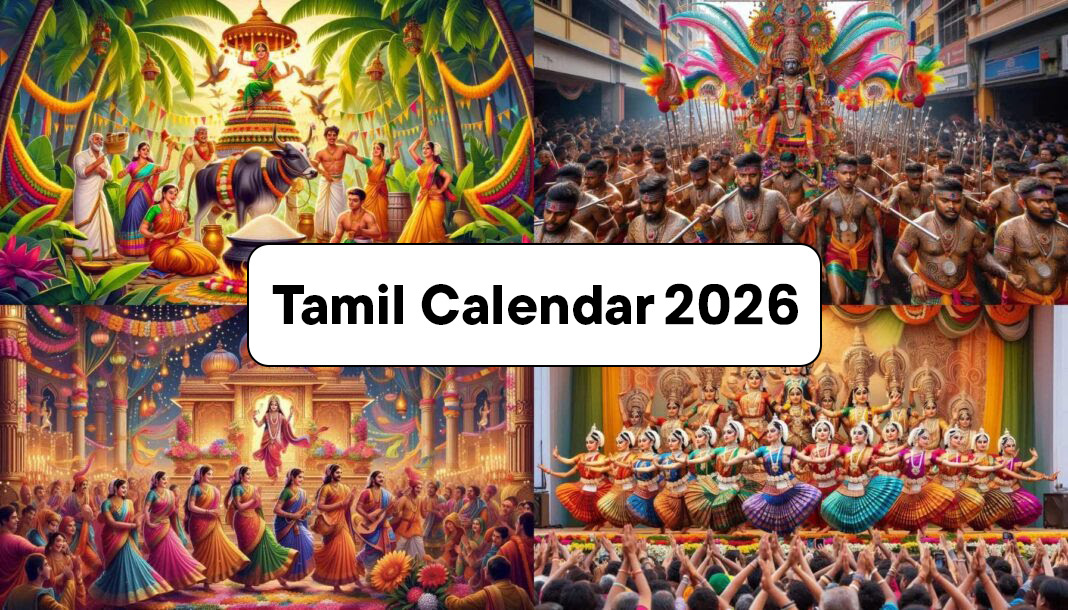
Plan your year with this comprehensive guide to Tamil festivals, vrats, and cultural observances in 2026 according to the traditional Tamil calendar.
Tamil Calendar 2026: January
|
Date |
Day |
Tamil Festival/Holidays |
|
03 January |
Saturday |
Aarudra Darshanam |
|
07 January |
Wednesday |
Tyagarajar Aradhanai |
|
11 January |
Sunday |
Koodaravalli |
|
13 January |
Tuesday |
Bhogi |
|
14 January |
Wednesday |
Pongal Festival |
|
15 January |
Thursday |
Mattu Pongal |
|
17 January |
Saturday |
Uzavar Thirunaal |
|
18 January |
Sunday |
Thai Amavasai |
|
23 January |
Friday |
Vasantha Panchami |
|
25 January |
Sunday |
Ratha Sapthami |
Tamil Calendar 2026: February
|
Date |
Day |
Tamil Festival/Holidays |
|
01 February |
Sunday |
Thai Poosam |
|
15 February |
Sunday |
Maha Shivaratri |
Tamil Calendar 2026: March
|
Date |
Day |
Tamil Festival/Holidays |
|
03 March |
Tuesday |
Maasi Magam |
|
14 March |
Saturday |
Karadaiyan Nombu |
|
19 March |
Thursday |
Ugadi - Telugu New Year |
|
27 March |
Friday |
Sri Rama Navami |
Tamil Calendar 2026: April
|
Date |
Day |
Tamil Festival/Holidays |
|
01 April |
Wednesday |
Panguni Uthiram |
|
14 April |
Tuesday |
Puthandu |
|
15 April |
Wednesday |
Vishu |
|
19 April |
Sunday |
Akshaya Tritiya |
|
21 April |
Tuesday |
Sankara Jayanti |
|
22 April |
Wednesday |
Ramanuja Jayanti |
Tamil Calendar 2026: May
|
Date |
Day |
Tamil Festival/Holidays |
|
01 May |
Friday |
Chitra Pournami |
|
04 May |
Monday |
Agni Nakshatram Begins |
|
28 May |
Thursday |
Agni Nakshatram Ends |
|
30 May |
Saturday |
Vaikasi Visagam |
Tamil Calendar 2026: June
|
Date |
Day |
Tamil Festival/Holidays |
|
26 June |
Friday |
Muharram |
Tamil Calendar 2026: July
|
Date |
Day |
Tamil Festival/Holidays |
|
12 July |
Sunday |
Masa Shivratri, Pradosham |
|
17 July |
Friday |
Sabarimala Nada Thurappu |
|
30 July |
Thursday |
Thiruvona Vratham |
Tamil Calendar 2026: August
|
Date |
Day |
Tamil Festival/Holidays |
|
03 August |
Monday |
Aadi Peruku |
|
12 August |
Wednesday |
Aadi Amavasai |
|
14 August |
Friday |
Aadi Pooram |
|
17 August |
Monday |
Garuda Panjami |
|
21 August |
Friday |
Varalakshmi Vratham |
|
26 August |
Wednesday |
Onam |
|
27 August |
Thursday |
Aavani Avittam / Rik / Yajurveda Upakarma |
|
28 August |
Friday |
Gayathri Japam |
|
31 August |
Monday |
Hara Chathurthi |
Tamil Calendar 2026: September
|
Date |
Day |
Tamil Festival/Holidays |
|
04 September |
Friday |
Gokulashtami |
|
12 September |
Saturday |
Avani Avittam |
|
14 September |
Monday |
Ganesh Chathurthi / Pillaiyar Chaturthi |
|
29 September |
Tuesday |
Maha Bharani |
Tamil Calendar 2026: October
|
Date |
Day |
Tamil Festival/Holidays |
|
07 October |
Wednesday |
Magha Shraddha |
|
10 October |
Saturday |
Mahalaya Amavasai |
|
11 October |
Sunday |
Navarathiri Aarambam |
|
19 October |
Monday |
Saraswathi Poojai / Ayudha Poojai |
|
20 October |
Tuesday |
Vijaya Dasami |
|
21 October |
Wednesday |
Vidyarambham |
Tamil Calendar 2026: November
|
Date |
Day |
Tamil Festival/Holidays |
|
08 November |
Sunday |
Deepavali |
|
10 November |
Tuesday |
Kandha Sashti Aarambam |
|
15 November |
Sunday |
Maha Kandha Sashti |
|
24 November |
Tuesday |
Karthigai Deepam |
Tamil Calendar 2026: December
|
Date |
Day |
Tamil Festival/Holidays |
|
15 December |
Tuesday |
Subrahmanaya Shasti |
|
20 December |
Sunday |
Vaikunda Ekadashi |
|
24 December |
Thursday |
Arudra Darshan |
Tamil Calendar 2026: Timekeeping, Tradition, and Cultural Continuity
The Tamil Calendar 2026 represents a distinctive and time-tested system that reflects the cultural discipline, spiritual depth, and seasonal awareness of Tamil society. Unlike modern calendars that focus primarily on numerical dates, the Tamil calendar is based on solar movement, planetary transitions, and natural cycles. For centuries, it has guided religious observances, agricultural practices, and important social milestones across Tamil Nadu and Tamil-speaking communities worldwide. In 2026, the Tamil calendar continues to remain deeply relevant. It shapes temple rituals, festival planning, auspicious timings, and household traditions, offering a structured rhythm to life that harmonizes faith, nature, and social order.
Chithirai: Beginning of the Tamil Year
The Tamil year begins with Chithirai, marking a symbolic transition toward renewal and clarity. The New Year is observed with temple visits, special prayers, and family gatherings, reflecting hope for stability, prosperity, and spiritual balance. Viewing the Panchangam on this day is considered auspicious, as it provides guidance for the year ahead. Cultural activities such as devotional music, classical dance, and literary programs often accompany New Year observances, reinforcing Tamil society’s long-standing emphasis on knowledge, discipline, and artistic expression.
Thai Month: Prosperity and Social Progress
The month of Thai holds special importance in the Tamil calendar, as it signifies progress, prosperity, and positive change. Traditionally associated with agricultural abundance, this period reflects gratitude toward nature and collective effort. Social celebrations in Thai emphasize family unity, sharing of food, and respect for farming traditions. The belief that “Thai brings new beginnings” continues to influence social customs and community events in 2026.
Devotional Months: Aadi and Margazhi
Certain months in the Tamil calendar are dedicated to heightened spiritual discipline. Aadi is closely associated with the worship of the Divine Mother and is observed through fasting, temple visits, and community rituals. Devotees seek protection, harmony, and well-being during this period, making it spiritually significant. Margazhi, on the other hand, is considered a sacred month of devotion and introspection. Early morning prayers, recitation of devotional hymns, and temple processions mark this time. Margazhi in 2026 continues to symbolize purity, discipline, and spiritual refinement.
Vinayaka Chaturthi and Shaivite Observances
Vinayaka Chaturthi holds a prominent place in the Tamil religious calendar. Dedicated to Lord Ganesha, the festival emphasizes wisdom, humility, and the removal of obstacles. Homes and temples conduct special prayers, reflecting values of ethical living and inner clarity. Shaivite observances such as Pradosham and Maha Shivaratri are equally important. These occasions involve fasting, temple worship, and night-long prayers, reinforcing spiritual discipline and devotion within everyday life.
Navaratri: Spiritual and Cultural Expression
Navaratri in Tamil culture is a blend of devotion and artistic celebration. The tradition of Golu, where decorative displays of dolls depict mythological stories and social themes, plays a central role. Families invite visitors, exchange knowledge, and participate in devotional gatherings. Classical music concerts, dance performances, and spiritual discourses form an integral part of Navaratri celebrations. Navaratri 2026 once again highlights Tamil Nadu’s ability to integrate spirituality with cultural creativity.
Karthigai: Festival of Light and Awareness
The month of Karthigai is associated with light, knowledge, and spiritual awakening. Lamps are lit in homes and temples to symbolize the removal of ignorance and the presence of divine wisdom. Major temples observe special rituals during this month, attracting devotees from across regions. This period emphasizes inner purification, devotion, and moral discipline, reinforcing the symbolic importance of light in Tamil spiritual thought.
Auspicious Days and Social Customs
The Tamil calendar plays a crucial role in determining auspicious days for weddings, naming ceremonies, housewarmings, and other life events. Planetary positions, lunar phases, and traditional calculations are carefully considered. Observances such as Amavasai and Pournami promote spiritual balance and remembrance of ancestors.
Contemporary Relevance of the Tamil Calendar
Despite rapid urbanization and digital lifestyles, the Tamil Calendar 2026 continues to guide both personal and community life. Digital almanacs and mobile applications have modernized access, enabling younger generations and the global Tamil diaspora to remain connected to traditional practices with ease.
Conclusion
The Tamil Calendar 2026 is far more than a traditional timekeeping system, it is a structured cultural framework that sustains Tamil identity, spirituality, and social values. By aligning human activity with nature, ethical discipline, and devotion, it preserves a way of life that remains meaningful in contemporary society. Rooted in continuity, balance, and tradition, the Tamil calendar continues to serve as a timeless guide for Tamil culture and heritage.
We hope this detailed guide from Starzspeak helps you navigate the auspicious year of 2026. Thank you for reading! Feel free to share this valuable resource with your family and friends.


Unit 303,304,305, Tower 4, DLF CORPORATE GREENS, Southern Peripheral Rd, Sector 74A, Gurugram, Haryana 122004


Powered by Mirth Media Group
Copyright © 2024 StarzSpeak. All Right Reserved.